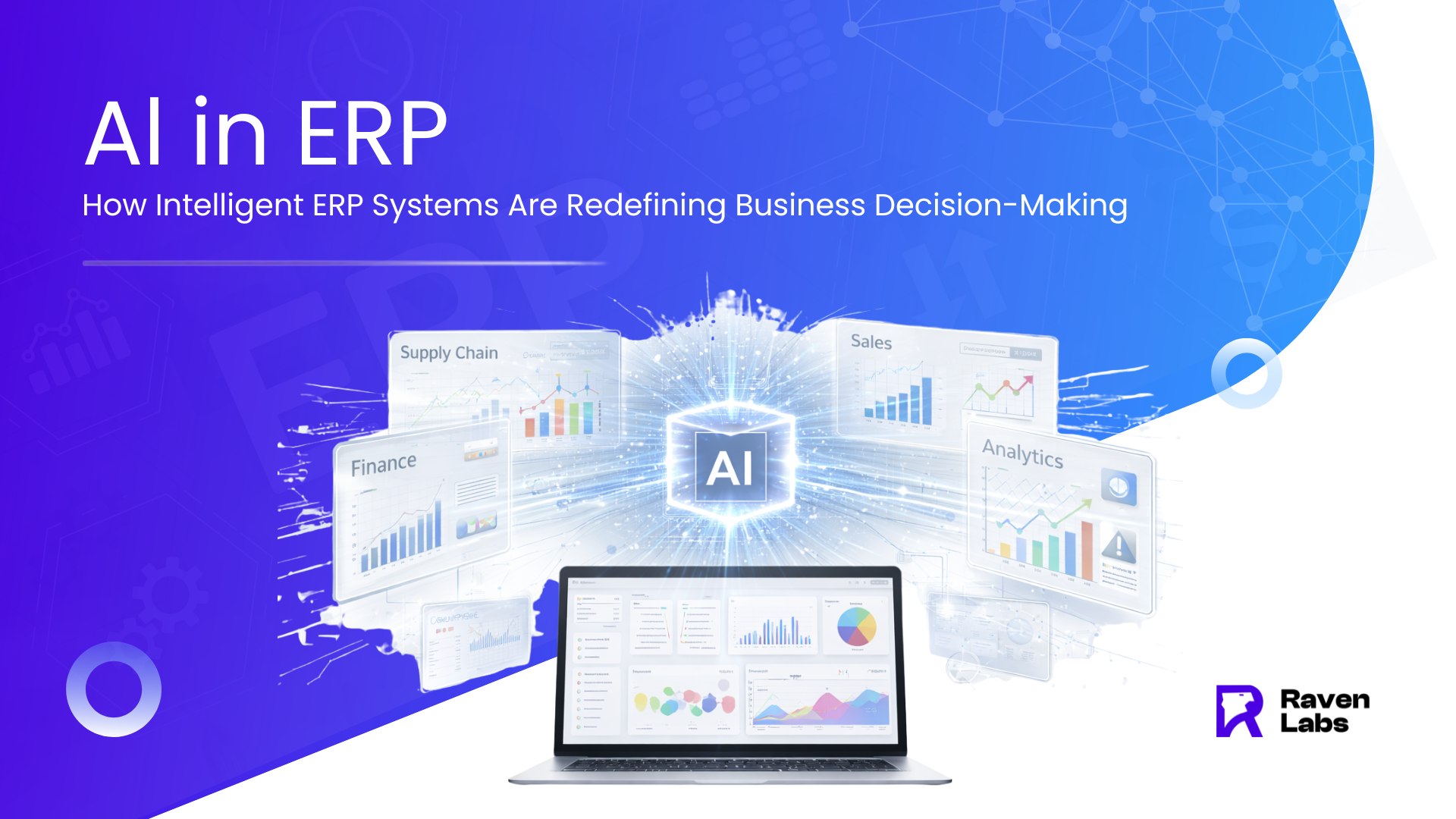
Enterprise Resource Planning systems have always played a critical role in managing core business operations. However, as businesses face increasing data volumes, market volatility, and rising customer expectations, traditional ERP systems are no longer sufficient. This is where AI ERP becomes transformative, ushering in a new era of intelligent enterprise management.
AI and ERP systems move organizations beyond static reporting and rule-based workflows into a new era of intelligent, adaptive, and predictive enterprise management. By embedding artificial intelligence directly into ERP platforms, businesses can analyze data in real time, implement business process automation, and make faster, more accurate decisions.
Today, ERP is evolving from a system of record into a system of intelligence – and AI is the driving force behind this shift. The integration of AI and ERP is creating powerful AI-enhanced ERP systems that are revolutionizing how businesses operate and make decisions.
What Is AI in ERP?
AI in ERP refers to the integration of artificial intelligence technologies such as machine learning, predictive analytics, natural language processing, and intelligent process automation into ERP systems.
Traditional ERP platforms are designed to collect, store, and organize data. While effective, they rely heavily on manual analysis and predefined rules. AI-driven ERP solutions, on the other hand, continuously learn from data, identify patterns, predict outcomes, and recommend or even execute actions automatically.
How AI ERP Changes Enterprise Capabilities
| Traditional ERP | AI-Enhanced ERP |
| Historical data reporting | Predictive and prescriptive insights |
| Manual analysis | Automated intelligence |
| Rule-based workflows | Self-learning automation |
| Reactive decision-making | Proactive decision-making |
| Limited forecasting | High-accuracy forecasting |
With AI embedded, ERP systems become active participants in decision-making rather than passive data repositories, enabling data-driven decisions across the organization.
Why ERP AI Is No Longer Optional ?
In today’s fast-paced business environment, decision speed and accuracy determine competitiveness. Organizations that rely on manual reporting and fragmented systems struggle to keep up.
ERP with AI enables businesses to:
- Process massive datasets in real time
- Predict trends and risks before they occur
- Implement robotic process automation for routine and complex workflows
- Reduce operational costs and errors
- Improve agility and responsiveness
- Enhance customer and employee experiences
Instead of asking “What happened?”, AI-powered ERP systems answer “What will happen next, and what should we do now?” This shift from reactive to proactive management is a game-changer for modern enterprises.
Core Benefits of AI-Driven ERP Solutions
Smarter, Data-Driven Decision-Making
AI in ERP analyzes structured and unstructured data to surface insights that humans might miss. Leaders gain confidence in decision-making through real-time intelligence and AI decision support, leading to more informed and strategic choices.
Predictive Analytics in ERP
Predictive analytics is one of the most powerful applications of AI ERP. AI models forecast demand, revenue, inventory needs, and cash flow, helping organizations plan proactively rather than reactively. This capability transforms planning and strategy across all business functions.
Intelligent Process Automation
AI-powered ERP automates tasks such as invoice matching, approvals, demand planning, scheduling, and exception handling. This intelligent process automation reduces manual effort while improving speed and accuracy, allowing employees to focus on higher-value tasks.
Real-Time Visibility Across the Enterprise
AI-driven dashboards provide live views of KPIs, financial health, supply chain performance, and operational risks, enabling faster responses to changing conditions. These real-time insights empower decision-makers at all levels of the organization.
Continuous Learning and Optimization
Unlike traditional ERP systems, AI-enhanced ERP continuously improves. Models learn from outcomes and refine predictions over time, leading to better performance and efficiency. This adaptive capability ensures that the ERP system evolves with the business.
AI in ERP: Real-World ERP System Examples
Modern ERP platforms are embedding AI as a core capability rather than an add-on. Below are practical ERP system examples that demonstrate how AI ERP works in real business environments.
Microsoft Dynamics 365
Microsoft Dynamics 365 is a leading example of AI-powered ERP in action. AI is embedded across finance, supply chain, operations, sales, and customer service.
Key AI ERP capabilities include:
- Predictive demand forecasting
- Intelligent budgeting and financial planning
- AI-driven anomaly detection and AI risk management
- Natural language interaction through AI copilots
- Automated approvals and workflows
- Real-time analytics with Power BI
Dynamics 365 demonstrates how AI transforms ERP into an intelligent decision-making platform rather than just a transactional system.
Other ERP System Examples with AI Capabilities
- SAP S/4HANA – Uses machine learning for finance, logistics, and manufacturing optimization
- Oracle NetSuite – Applies AI to forecasting, planning, and anomaly detection
These ERP systems highlight a clear trend: AI-driven ERP solutions are becoming standard, not optional.
Department-Level Use Cases of AI ERP
AI in ERP for Finance
AI automates expense classification, fraud detection, cash flow forecasting, and budget variance analysis. Finance leaders gain real-time visibility into financial risks and opportunities, enabling faster and more accurate decisions. AI risk management capabilities help identify and mitigate potential financial threats before they materialize.
AI in ERP for Supply Chain Management
AI-driven ERP systems forecast demand, optimize inventory levels, improve logistics planning, and reduce waste. Businesses can prevent stockouts and overstocking through predictive insights, leading to more efficient and responsive supply chains.
AI in ERP for Human Resources
AI analyzes employee performance data, attrition risks, hiring trends, and workforce demand. HR teams can make smarter talent decisions based on data-driven insights, improving recruitment, retention, and overall workforce management.
AI in ERP for Sales and Marketing
AI-powered ERP improves lead scoring, sales forecasting, customer segmentation, and campaign personalization. This leads to higher conversion rates and better ROI, as marketing and sales teams can target their efforts more effectively.
AI in ERP for Manufacturing
In manufacturing, AI supports predictive maintenance, production scheduling, quality control, and capacity planning. Equipment failures are predicted before they happen, reducing downtime and optimizing production processes.
AI in ERP for Retail
Retail ERP systems with AI predict buying behavior, optimize inventory by location, personalize promotions, and analyze real-time sales data to respond quickly to trends. This enables retailers to provide better customer experiences and manage their operations more efficiently.
Best Practices for Implementing AI-Enhanced ERP
To maximize value from AI-driven ERP solutions, organizations should follow these best practices:
Start with High-Impact Use Cases
Begin with areas like forecasting, automation, or reporting where AI can deliver immediate value. This approach helps build momentum and demonstrate ROI quickly.
Define Clear Business Objectives
Identify measurable goals such as cost reduction, faster decision-making, or improved accuracy. Align AI ERP initiatives with overall business strategy to ensure meaningful outcomes.
Ensure Data Readiness
AI relies on clean, integrated, and high-quality data. Strong data governance is essential for the success of AI-powered analytics and decision support systems.
Upskill Teams
Train employees to interpret AI insights and collaborate effectively with intelligent ERP systems. This ensures that the organization can fully leverage the capabilities of AI-enhanced ERP.
Monitor, Measure, and Improve
AI models should be continuously evaluated and refined to ensure long-term success. Implement a feedback loop to continuously improve the accuracy and relevance of AI-driven insights.
The Future of AI in ERP Systems
The future of AI in ERP is moving toward self-driving ERP systems – platforms that autonomously learn, adapt, and optimize processes with minimal human intervention.
These intelligent ERP systems will not only recommend actions but execute them within defined governance frameworks. As AI maturity grows, ERP will become the central nervous system of the intelligent enterprise, driving innovation and competitive advantage.
Conclusion: AI in ERP Is the Foundation of the Intelligent Enterprise
AI in ERP systems is no longer a future trend – it is a present-day competitive necessity. Organizations that adopt AI-powered ERP gain predictive intelligence, automation, and agility that traditional systems simply cannot deliver.
ERP system examples like Microsoft Dynamics 365 show how AI transforms ERP from a transactional platform into a strategic decision-making engine. Businesses that embrace AI-enhanced ERP will unlock higher productivity, smarter insights, and sustainable growth.
If your organization is ready to move beyond static reports and manual processes, now is the time to invest in AI-driven ERP solutions and build a truly intelligent enterprise. By leveraging the power of AI and ERP together, businesses can navigate the complexities of the modern marketplace with confidence and agility.
FAQ’S
1. What is AI in ERP?
AI in ERP refers to embedding artificial intelligence technologies into ERP systems to analyze data, automate processes, and support smarter decision-making. It enables ERP platforms to move beyond data storage and actively drive business insights.
2. How does AI improve ERP systems?
AI improves ERP systems by providing predictive insights, intelligent automation, and real-time analytics. This helps businesses make faster, more accurate decisions with less manual effort.
3. Why is AI in ERP important for modern businesses?
AI in ERP is important because it allows organizations to respond quickly to market changes and reduce operational inefficiencies. It improves forecasting accuracy, automation, and overall business agility.
4. What are the key benefits of AI-powered ERP systems?
AI-powered ERP systems offer predictive analytics, automated workflows, and real-time visibility across operations. These benefits lead to better decision-making, lower costs, and improved productivity.
5. Can AI in ERP automate business processes?
Yes,AI in ERP can automate processes such as invoice matching, approvals, demand planning, and reporting. Advanced systems can also adapt workflows based on data patterns.