
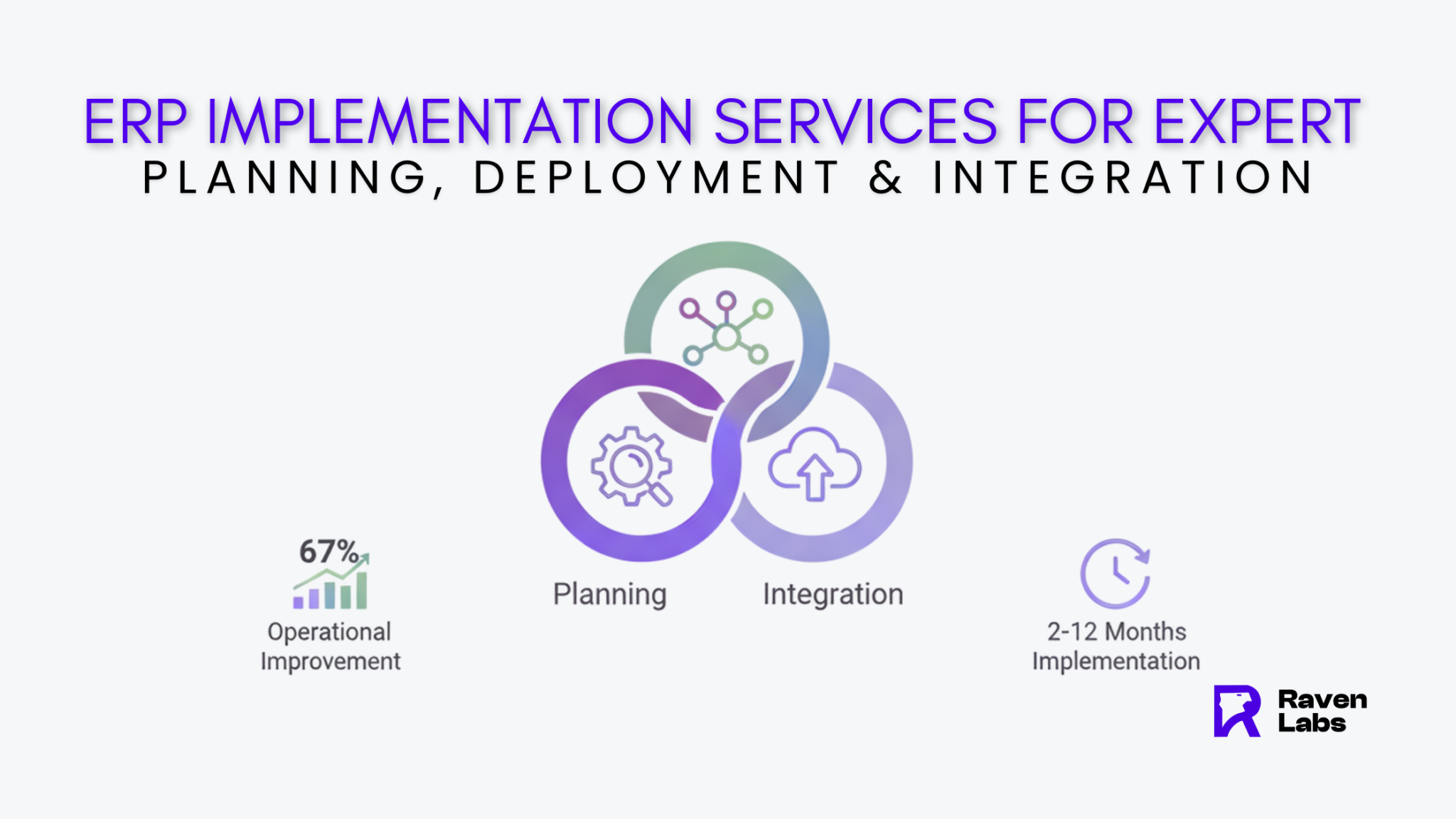
A successful ERP implementation plan brings together technology, people, and processes seamlessly. Research indicates that companies can achieve 90% on-time completion rates by managing project risks effectively. Your business transformation needs the right ERP Implementation Services and partnership with an experienced ERP Implementation Company.
This piece guides you through planning, deploying, and integrating your new ERP system to help you achieve the operational improvements that make your investment count.
Defining ERP Implementation Services in a Modern Business Context
ERP implementation services have changed by a lot to meet modern business needs. They need a more strategic and complete approach than before. These services are the foundation of business transformation initiatives that help organizations naturally move from legacy systems to integrated enterprise solutions.
What ERP Implementation Services Include
ERP implementation is the process of planning, configuring, and deploying an enterprise resource planning system. It integrates key business functions like finance, supply chain, human resources, manufacturing, and customer relationship management. The complexity of automating and connecting multiple business processes makes this approach take several months.
A complete ERP system implementation process has:
- Discovery and Planning: Setting project direction, scope, structure, and clear objectives
- Design: Configuring the system based on business requirements and process redesign
- Development: Customizing the solution to match unique organizational needs
- Testing: Thorough validation to ensure system performance meets requirements
- Deployment: Launching the new system with minimal disruption
- Support: Ongoing maintenance and optimization after implementation
The goal goes beyond software installation. It aims to revolutionize company operations by streamlining processes, cutting inefficiencies, and improving decisions through unified data systems. This transformation needs careful planning, collaboration, and adaptation at all organizational levels.
Why Expert Planning Matters in ERP Projects
ERP projects are multi-million-dollar investments that organizations must manage well. Research shows that 95% of businesses see major process improvements after implementing an ERP system correctly. These numbers show why expert planning is essential.
Original planning builds a strong foundation for the entire implementation project. It ensures high-level support, clear objectives, and proper resource allocation. Without proper preparation, organizations risk facing big problems later in the project lifecycle.
Many businesses sped up their digital transformation during the pandemic by implementing ERP systems. In spite of that, a recent survey found that many implementations failed to deliver promised value. They were executed as stand-alone projects without enough coordination or oversight. This shows why project management by experienced professionals is vital.
A well-designed implementation plan splits the project into phases with clear objectives. This phased approach leads to success by building each stage on previous achievements while staying aligned with strategic goals.
Role of ERP Consulting Companies in Australia
ERP consulting companies in Australia are strategic partners throughout the implementation process. These specialized firms bring industry expertise and technical knowledge that many organizations don’t have internally. Australian businesses benefit from local consultants who ensure proper system localization, reliable support, and alignment with ATO compliance requirements like GST, BAS, and superannuation reporting.
ERP consultants work with businesses of all sizes – from manufacturing and retail to healthcare and professional services. They create ERP strategies that fit unique business requirements. Their main responsibilities include:
- Conducting full requirement analysis to assess business needs
- Defining project scope and creating realistic timelines
- Managing the complete implementation lifecycle
- Helping with data migration and system integration
- Providing thorough user training and change management support
- Ensuring continuous system optimization after implementation
Mid-sized companies especially need external expertise since most don’t have the experience or skills to manage complex projects internally. Working with certified, local implementation partners like official Microsoft Partners is a great way to get proven expertise and reliable support throughout the project lifecycle.
Building a Strong ERP Implementation Plan
Organizations need meticulous planning for successful ERP system implementation. Yet 30% of organizations skip this significant step, which leads to extended project timelines. Building a strong ERP implementation plan might seem overwhelming at first, but it serves as the life-blood of your entire project.
Setting Measurable Goals and KPIs
Your desired outcomes must be clearly defined to create an effective ERP implementation plan. Organizations should set specific business goals they want to achieve with their new ERP system, rather than focusing only on technology. Better operational efficiency, lower costs, higher customer satisfaction, and improved data accuracy are some common objectives.
Your “implementation success plan” will act as your North Star. This plan helps prevent scope creep and uncertain implementation timelines. You should follow these steps to get the best results:
- Define specific KPIs before implementation begins
- Take standard measurements to track progress
- Set metrics that line up with strategic business priorities
Inventory turnover, order processing time, project margins, demand forecasting accuracy, and employee satisfaction are popular KPIs that measure implementation success. Operational metrics tracking will help you spot areas where your new system meets, exceeds, or falls short of expectations.
Planning to Implement ERP Without Business Disruption? Get expert-led ERP planning, deployment, and system integration from certified professionals. Book a Free ERP Implementation Consultation with Raven Labs Australia.
Choosing Between Big Bang, Phased, and Hybrid Approaches
Your organization’s needs, budget, and timeline will determine the right implementation strategy. Three main approaches stand out:
- Big Bang Approach: This method implements the complete ERP system across the organization at once. Quick benefits and faster ROI are advantages, but it comes with higher risks and a steeper learning curve. Many organizations pick this approach when they don’t want to integrate the new ERP with legacy systems scheduled for retirement.
- Phased Approach: The ERP system rolls out in multiple waves, starting with one business unit or function. Users can provide feedback with lower stakes if unexpected issues pop up. This approach takes longer but lets you test individual components as they go live.
- Hybrid Approach: This method blends both strategies by implementing core modules through big bang while gradually phasing in others. Organizations can achieve faster ROI on critical modules and delay non-essential ones, striking a balance between speed and risk.
Aligning ERP Strategy with Business Objectives
Your ERP system should power your strategic vision. A good ERP strategy needs system capabilities that directly connect to corporate objectives. This alignment will ensure your time and money investment supports your organization’s key goals.
Here’s how to line up your ERP strategy with business objectives:
- Run a strategic business analysis to identify key objectives and pain points
- Map out clear business processes and ERP system requirements
- Create a multi-year ERP roadmap that sequences rollouts based on business priorities
- Link specific ERP capabilities to strategic goals
Your implementation plan should look ahead to system upgrades and scaling as your business grows. Each requirement deserves evaluation based on its measurable business outcome and implementation difficulty.
Senior management must stay involved throughout the process. Project teams need executive support to secure resources and implement organization-wide changes. Executive buy-in should be secured before the ERP implementation begins to show organizational dedication.
Selecting the Right ERP Implementation Partner
Your ERP project’s success largely depends on choosing the right implementation partner. This decision carries the same weight as picking the software itself. A recent industry assessment shows about 31 firms stand out as major players among Australian consulting companies.
Evaluating ERP Implementation Companies in Australia
Marketing claims alone won’t tell the full picture. Here are the critical factors to evaluate potential partners:
- Experience and methodology: Your partner needs proven experience with your chosen solution in your industry
- Technical capabilities: They should know how to handle customizations and connect with third-party systems
- Project management approach: The team structure and communication style throughout the project matter
- Trust and cultural alignment: Your partner’s values should line up with yours since their consultants become part of your team
Australian ERP implementation companies come in different tiers. Tier 1 vendors work globally, tier 2 vendors stick to regions, and tier 3 vendors focus on single countries. Local providers often create economical solutions that fit specific business needs, unlike global solutions that might pack unnecessary features.
Industry-Specific Expertise in Microsoft Dynamics ERP
Your sector’s knowledge plays a crucial role in implementation success. Partners who know your industry understand its processes, challenges, and rules. This knowledge helps them develop solutions that line up with your business needs quickly.
Microsoft Dynamics ERP certified experts help optimize implementation for success and stability. These professionals set up systems using industry best practices while adapting to your unique operational requirements.
Book a Free ERP Implementation Consultation with Raven Labs Australia.
Raven Labs Australia: ERP Expertise
Local expertise brings clear advantages over remote implementation partners. Implementation specialists point out that face-to-face meetings help break down communication barriers. These real-life connections work better than virtual meetings. Local partners also set up systems better because they understand regional business processes and compliance needs.
Raven Labs works as a strategic partner for CRM and ERP solutions. They customize implementations to boost productivity with minimal disruptions. Unlike typical implementation partners, they aim to be a strategic collaborator that lines up technology with growth goals. As Microsoft Dynamics 365 experts, they help optimize efficiency and connected intelligence to maximize digital transformation ROI.
The right implementation partner needs expertise, solid methodologies, and a good cultural fit with your organization. These factors will shape your project’s long-term success.
Core Phases of End-to-End ERP Implementation
ERP system implementation has four key technical phases that need proper management to work well. Let’s get into each phase and see how they affect implementation success.
System Configuration and Customization
The technical foundation of any ERP implementation starts by telling configuration and customization apart. Configuration adjusts built-in settings within the ERP software to match specific business needs without changing source code. This method leads to faster implementation, lower costs, and smoother upgrades. Customization, on the other hand, changes the system’s code to add unique functions not available through standard settings. Configuration usually stays safe during upgrades, but customization brings extra costs and risks that need careful review before moving forward.
Data Migration and Cleansing Strategy
Data migration stands out as one of the toughest parts of ERP implementation and takes up 10-15% of total project costs. A winning strategy needs analysis of existing data sources, data mapping to the new system’s structure, and clear data ownership. Companies should be selective about transferring data and avoid moving all historical information. The focus should be on cleaning and prioritizing data based on business value to keep the system’s performance and data integrity strong.
User Acceptance Testing (UAT) and Quality Assurance
UAT works as the final check where end-users test the software in real-life scenarios before deployment. This crucial step helps find bugs, workflow issues, and usability problems that technical testing might miss. The best results come from a detailed UAT plan that specifies test scenarios, responsibilities, testing time, and reporting methods. Quality assurance throughout implementation helps verify that the ERP system meets all requirements in business functions of all sizes.
Training and Change Management Planning
The human factor remains key to ERP success. Role-based training programs and change management strategies encourage user adoption. Training should focus on specific processes each user group will handle in the new system. Change management helps employees adjust to new workflows and responsibilities both mentally and emotionally.
Post-Go-Live Support and Measuring ERP ROI
Your ERP system implementation’s completion opens the door to its most vital phase – the moment when actual value emerges. The success of your investment depends on excellent post-go-live support.
Ongoing Support and System Optimization
A dedicated hypercare phase should start right after deployment. The team must perform daily system health checks with quick responses to urgent problems. This support strategy has technical fixes, maintenance updates, and user help that keeps the system running smoothly. Companies with proper post-implementation support experience better system performance and happier users.
Tracking ROI Through Operational KPIs
Success in ERP implementation needs both financial and operational metrics tracking. These essential indicators show the true picture:
- Financial metrics: Cash-to-cash cycle time and days sales outstanding (DSO)
- Inventory performance: Turnover rates, carrying costs, and forecast accuracy
- Efficiency gains: Throughput improvements and schedule adherence
Companies typically see measurable ROI within 12-18 months after implementation when they track these metrics consistently.
Continuous Improvement and Feature Expansion
Your ERP implementation should be seen as an ongoing trip, not a final stop. A solid improvement plan helps your system grow with your business’s changing needs. Regular user feedback, performance metric reviews, and workflow adjustments reveal optimization opportunities. Companies that spend 15-20% of their post-implementation budget on training and support achieve peak system efficiency.
Conclusion
ERP implementation is a transformative experience for businesses aiming to excel in their operations. Two-thirds of organizations see operational improvements within their first year. Professional implementation services help bridge the gap between buying technology and getting real business value.
Expert planning is the life-blood of successful ERP projects. Organizations should set clear objectives and define proper KPIs. They need to pick implementation approaches that line up with their specific needs. The right strategy – Big Bang, Phased, or Hybrid – depends on how ready the organization is, its risk tolerance, and what it wants to achieve.
Picking the right implementation partner matters as much as choosing the software. Local expertise brings clear advantages, especially with compliance requirements. Face-to-face collaboration beats virtual meetings. Partners who know your industry understand related processes and challenges. This leads to faster solutions that match business requirements.
Technical implementation phases need close attention. System setup, data migration, user acceptance testing, and change management each bring their own challenges. These tasks need special expertise. Companies should balance their desire for customization against what they can maintain long-term.
Your ERP investment’s lasting returns depend on post-implementation support. Companies with proper post-go-live support see big improvements in how their system runs and how happy users are. Most see measurable ROI within 12-18 months if they track key metrics and keep improving.
ERP implementation goes beyond being just a technology project – it’s about business transformation. Success comes from careful planning, smart partner selection, and staying committed to getting better. Companies that take a strategic approach set themselves up for better operations, clearer data insights, and improved efficiency. These benefits make the big investment worth it.
FAQs
Q1. What are the key stages of ERP implementation?
ERP implementation typically involves several stages, including discovery and planning, system selection, design, installation and configuration, testing and quality assurance, deployment and training, and continuous improvement. Each stage is crucial for ensuring a successful implementation and maximizing the system’s benefits.
Q2. How long does it usually take to implement an ERP system?
The timeline for ERP implementation can vary depending on the organization’s size and complexity. Generally, it takes between two to nine months, though it can extend up to twelve months for more complex projects. Proper planning and expert guidance can help streamline the process and ensure timely completion.
Q3. What should businesses consider when choosing an ERP implementation partner?
When selecting an ERP implementation partner, businesses should evaluate factors such as industry experience, technical capabilities, project management approach, and cultural fit. It’s also beneficial to consider local partners who understand regional business processes and compliance requirements, especially for Australian companies.
Q4. How can organizations measure the success of their ERP implementation?
Organizations can measure ERP implementation success by tracking both financial and operational metrics. Key indicators include cash-to-cash cycle time, inventory turnover rates, efficiency gains, and forecast accuracy. Most businesses begin seeing measurable ROI within 12-18 months of implementation, provided they consistently monitor these metrics.
Q5. What is the importance of post-implementation support in ERP projects?
Post-implementation support is crucial for ensuring the long-term success of an ERP system. It involves ongoing maintenance, system optimization, and user assistance. Organizations that implement proper post-go-live support experience significant improvements in system performance and user satisfaction, maximizing the value of their ERP investment.
How to Use AI for…

How Microsoft Copilot in Dynamics…

Top 7 Benefits of Power…

Why Are Australian Businesses Choosing…
AI in ERP: How Intelligent…

Zoho Australia: How Zoho Partners…
End-to-End Digital Implementation, Automation &…

Zoho One Implementation Services in…

ERP Implementation Services for Expert…
