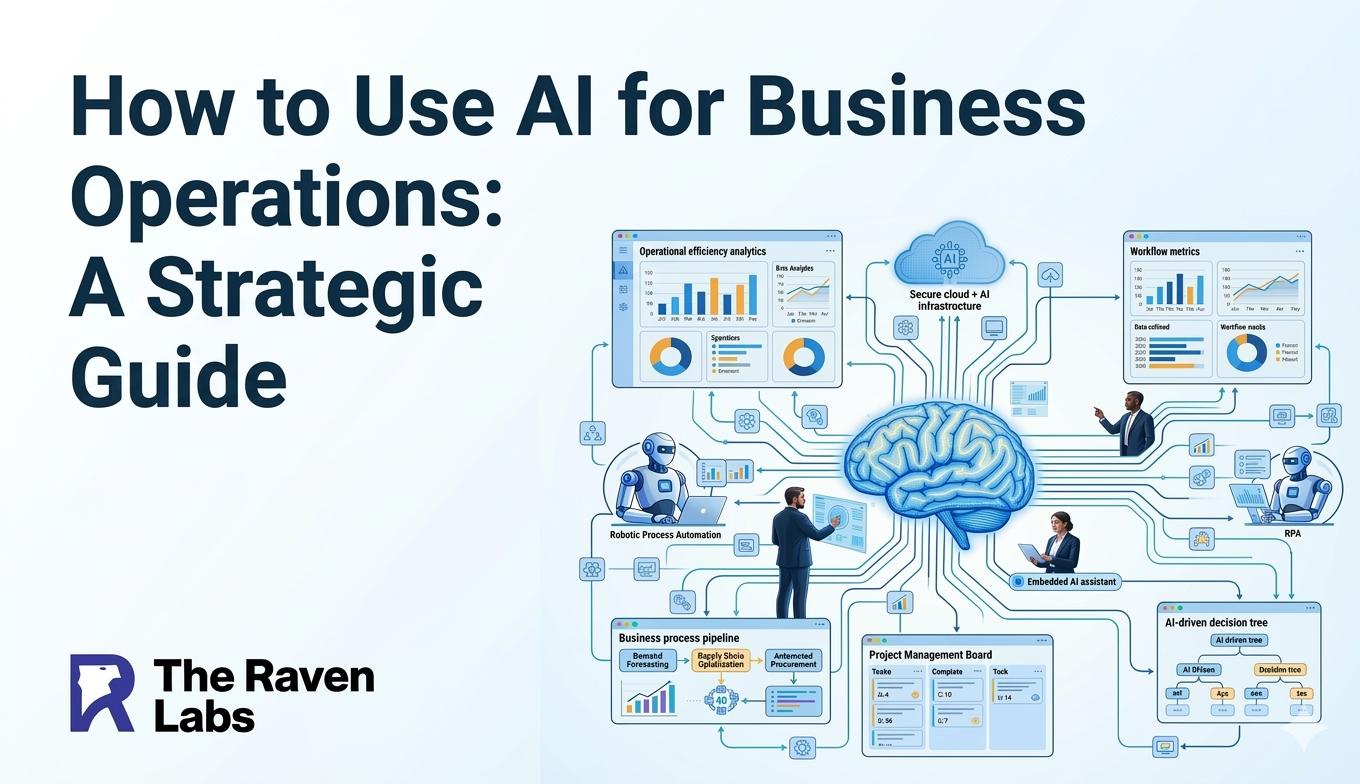
AI for business operations is transforming how companies work and the numbers prove it. Routine tasks consume up to 70% of employees’ time, but artificial intelligence automates these workflows and frees your team to focus on strategic priorities. AI-driven chatbots manage customer inquiries around the clock, predictive analytics sharpens decision-making, and intelligent systems reduce manual errors across every department.
Businesses across North America, Europe, and the Asia-Pacific region are already adopting AI for business automation to cut costs, accelerate processes, and scale with confidence. In this guide, we’ll show you exactly where to apply AI for maximum impact, how to build an AI automation strategy that delivers measurable returns, and how to overcome the challenges that derail most implementations.
What you’ll learn:
- The four highest-ROI areas for AI in business operations
- A step-by-step framework for building your AI automation strategy
- How to run AI pilot projects that scale
- How to avoid the mistakes that cause 80% of AI projects to fail
- Real-world results from enterprise AI adoption worldwide
What Is AI for Business Operations?
AI for business operations refers to the use of artificial intelligence technologies including machine learning, natural language processing, and predictive analytics to automate workflows, improve decision-making, and reduce costs across core business functions such as customer service, supply chain, marketing, and finance. It encompasses both task-level automation and strategic systems that adapt in real time to changing data and market conditions.
Where to Apply AI for Maximum Business Impact
Identifying the right areas for AI implementation determines whether your automation efforts deliver real returns or drain resources without meaningful effect. Based on operational outcomes across industries and geographies, four domains consistently produce the highest value from AI investment.
1. Customer Service and Support Automation
AI chatbots and virtual assistants handle customer questions without human intervention, operating continuously across every time zone. Gartner predicts that agentic AI will autonomously manage 80% of standard customer service queries by 2029, potentially reducing operational expenses by 30%.
Real-world results demonstrate the scale of impact. Bank of America’s AI virtual assistant, Erica, handles millions of customer questions and delivers financial guidance at scale substantially improving engagement and support efficiency. In the US retail sector, Camping World’s virtual assistant increased customer engagement by 40% across platforms while cutting average wait times to just 33 seconds.
In Europe, French telecommunications provider Bouygues Telecom deployed AI to analyse call centre data and enable agents to make personalised suggestions in real time resulting in a 30% reduction in pre- and post-call operations and projected savings exceeding $5 million. In the insurance sector, Lemonade’s AI chatbot Maya handles a quarter of all customer queries, has sold 1.2 million policies in three years, and processes new insurance purchases within 90 seconds.
AI for customer service in brief: AI chatbots and virtual assistants automate repetitive customer queries, operate 24/7, and significantly reduce cost-per-interaction. Gartner projects they will handle 80% of standard queries by 2029. Businesses deploying AI-powered support report 30–40% improvements in engagement and operational efficiency.
2. Marketing and Sales Process Optimization
AI marketing automation transforms how teams identify, score, and convert prospects. U.S. Bank implemented predictive lead scoring through Salesforce’s Einstein AI resulting in a 25% increase in closed deals, a 260% increase in lead conversion rates, and a 300% increase in marketing-qualified leads. These systems analyse historical data to predict which prospects best match your ideal customer profile, and automatically adjust messaging based on real-time engagement signals.
Across APAC markets, enterprises are increasingly deploying AI-driven personalisation engines and propensity models to improve both inbound and outbound sales efficiency compressing sales cycles and improving forecast accuracy.
3. Supply Chain and Inventory Management
AI-powered demand forecasting addresses one of the most costly operational challenges in global business: balancing inventory levels against unpredictable demand. Companies adopting AI-driven forecasting report accuracy rates reaching 95% with a 30% reduction in inventory waste.
Walmart’s AI algorithms analyse point-of-sale data, customer demographics, weather patterns, and social media sentiment to generate highly accurate demand forecasts at the individual product and store level. Lenovo’s Supply Chain Intelligence platform deployed across its global manufacturing and logistics operations integrates data from over 800 sources and delivered a 4.8% revenue increase, 5% improvement in on-time delivery, and nearly 20% reduction in manufacturing and logistics costs.
4. Financial Planning and Analysis
AI in financial planning and analysis automates data collection, variance analysis, and scenario modelling. Finance teams using modern AI-powered forecasting tools report spending 60% less time on data preparation shifting from backward-looking reporting to forward-thinking business partnership. Machine learning algorithms continuously refine forecasting models based on actual results and adapt automatically when market conditions shift.
AI for finance in brief: AI automates data collection, variance analysis, and scenario modelling in FP&A. Finance teams report 60% time savings on data preparation. Machine learning models self-refine as conditions change, enabling proactive financial strategy rather than reactive reporting.
How to Build an AI Automation Strategy for Your Business
More than 80% of business leaders have fewer than 18 months to execute an AI strategy before facing meaningful competitive risk. Yet over 80% of AI projects fail. The gap between those two realities is foundational planning.
Building an effective AI automation strategy starts with aligning technology decisions to measurable business objectives not chasing the latest AI trend.
Step 1 — Set Clear, Measurable Goals
How to set AI goals — in brief: Define specific KPIs tied to business priorities using the SMART framework (Specific, Measurable, Achievable, Relevant, Time-bound). Target concrete outcomes such as a 15% reduction in customer churn within 12 months rather than generic targets like “improve efficiency.” Clear metrics are what separate successful AI implementations from expensive experiments.
Your AI strategy needs specific, measurable goals anchored to business priorities not generic technology adoption metrics. Use the SMART framework to structure your planning. For example, a manufacturing company might target increasing average customer lifetime value by 15% within 12 months through AI-driven service recommendations. A logistics company might target reducing warehouse picking errors by 20% within six months using computer vision. The specificity of the goal determines the quality of the implementation.
Step 2 — Identify High-Impact Processes to Automate First
Where to start with AI automation — in brief: Focus on processes that are repetitive, high-volume, and error-prone such as invoice processing, customer query handling, or demand forecasting. Use a prioritisation matrix to weigh business impact against implementation readiness. Start with quick wins that build internal confidence before scaling to more complex integrations.
Evaluate automation candidates using a prioritisation matrix that scores each process on two dimensions: business impact and implementation readiness. Prioritise processes where both scores are high. Data entry, invoice processing, customer triage, and inventory replenishment are consistently strong starting points across industries.
Step 3 — Select AI Tools That Fit Your Business Needs
Tool selection must follow business requirements, not vendor marketing. Assess solutions based on:
- Integration capability with your existing ERP, CRM, and data infrastructure
- Vendor domain expertise and implementation track record
- Security architecture and data governance standards
- Total cost of ownership including implementation, training, and ongoing maintenance
- Flexibility to scale without requiring full platform overhauls
Evaluate whether you need a general-purpose AI platform (such as Microsoft Copilot or Google Gemini for Enterprise) or specialist tools built for specific functions such as Salesforce Einstein for sales AI or SAP AI Core for supply chain.
How to Implement AI for Operational Excellence
Execution separates successful AI initiatives from stalled pilots. Organisations that move from planning to implementation with structured approaches see measurable returns. Those that skip the execution framework watch projects consume budget without delivering results.
Start with Focused AI Pilot Projects
Select one high-value use case that delivers measurable results without overwhelming your team. Define the hypothesis you want to prove or disprove during the pilot. Issue limited licences across two to three departments to test real-world impact before scaling organisation-wide. Set a fixed timeframe — typically eight to twelve weeks and evaluate against pre-defined success metrics before committing to wider rollout.
Integrate AI with Existing Business Systems
AI-powered integration platforms streamline data synchronisation between ERP and CRM systems, enforce consistent business rules, and reduce the manual data management burden. APIs and middleware serve as bridges between legacy systems and modern AI solutions — preventing data bottlenecks and protecting existing infrastructure investments. Well-executed AI integrations typically begin delivering measurable value within four to twelve weeks of deployment.
By 2026, executives project that 85% of their workforce will make real-time, informed decisions using AI agent recommendations making integration quality a critical determinant of overall AI ROI.
Use AI for Continuous Process Improvement
AI accelerates continuous improvement methodologies by automating routine monitoring, eliminating process waste, and enhancing decision-making at every level. Machine learning analyses operational data patterns to forecast process failures, identify bottlenecks, and predict quality issues before they affect customers or revenue. This shifts teams from reactive problem-solving to predictive optimisation a structural competitive advantage.
Monitor and Adjust AI Performance
Track these core metrics consistently:
- Technical metrics: Model deployment velocity, uptime percentages, error rates, latency
- Business value metrics: Cost savings, time saved, conversion improvements, error reduction rates
- ROI metrics: Revenue impact, cost-per-transaction changes, customer satisfaction scores
Use dashboards that surface both technical performance and business impact in real time. AI systems require ongoing recalibration treat monitoring as a permanent operational function, not a post-launch task.
Build a Culture of Innovation Around AI
Leaders who openly share their AI experiments including setbacks and course corrections signal that responsible experimentation is safe. This cultural signal matters more than any training programme. Cross-functional collaboration amplifies AI impact: teams are three times more likely to deliver breakthrough outcomes when working across departmental boundaries. Research consistently shows that organisational adaptability has the strongest correlation with both AI programme success and revenue growth.
Common AI Adoption Challenges and How to Overcome Them
Technical capability alone does not guarantee successful AI implementation. Four recurring obstacles derail even well-planned initiatives.
Managing Employee Concerns and Change Management
Nearly half of employees (47%) say formal training is the most effective way to build AI adoption confidence yet more than one in five report receiving minimal to no support from their organisation. Gen Z employees show the highest concern, with 72% worried about automation affecting their roles.
Transparency is the most powerful change management tool available to leaders. Fifty-four percent of employees want the right to know when AI is monitoring their work. Fifty-two percent want human review of AI-driven decisions. Fifty percent want clear processes for challenging AI outcomes. Building these safeguards into your AI governance framework and communicating them proactively significantly accelerates adoption.
Controlling AI Implementation Costs
Research shows 60% of AI implementation projects exceed original budgets by 30% or more. Talent costs represent 40–50% of total implementation spend the largest single expense category for most organisations. Hidden costs that consistently catch businesses unprepared include legacy system modifications and regulatory compliance audits, which can add significant cost in regulated industries.
Build realistic budgets that include infrastructure, integration, change management, ongoing monitoring, and a 30–40% contingency buffer.
Ensuring Data Security and Regulatory Compliance
AI systems operating on EU citizen data must adhere to GDPR requirements. Data Protection Impact Assessments (DPIAs) are mandatory under Article 35 of GDPR for AI systems handling high-risk processes. Organisations must implement security reviews for all API endpoints to prevent non-compliant data ingestion and accidental leakage. The EU AI Act, now in force, adds additional compliance obligations for high-risk AI applications across European markets.
For businesses operating in APAC, Singapore’s Model AI Governance Framework and Japan’s AI Strategy provide practical compliance guidance alongside GDPR-equivalent considerations in markets like South Korea.
Selecting Trustworthy AI Vendors
Over 80% of AI projects fail due to misalignment between the technology purchased and the actual business problem being solved. Assess vendors on three dimensions: industry domain expertise, a verifiable track record with organisations facing similar challenges, and team depth beyond the sales conversation. AI development is inherently iterative it requires ongoing monitoring, testing, and recalibration. Select partners you trust to be constructive throughout a multi-year working relationship, not just during the sales cycle.
AI for Business Operations: Key Takeaways
Implementing AI for business operations is not a technology decision it is a strategic one. The organisations seeing the greatest returns share three characteristics: they started with a clearly defined, measurable business problem; they ran disciplined pilot projects before scaling; and they treated AI as an ongoing capability to develop rather than a one-time deployment.
The data is unambiguous. AI delivers 30–40% cost reductions in customer service, 95% demand forecast accuracy in supply chain, 260% lead conversion improvements in sales, and 60% time savings in financial planning. These are not projections they are documented outcomes from enterprises across North America, Europe, and APAC that implemented AI with strategic discipline.
Your competitors are already moving. The question is not whether to implement AI it is how quickly you can implement it well.
Frequently Asked Questions About AI for Business Operations
What is AI for business operations?
AI for business operations is the application of technologies including machine learning, generative AI, and intelligent automation to streamline workflows, reduce operational costs, and improve decision-making across departments — including customer service, finance, marketing, and supply chain management.
Where should a business start with AI implementation?
Start with a single high-impact, high-volume process that is repetitive and measurable — such as invoice processing, customer query handling, or demand forecasting. Define clear success metrics before launch, run a time-limited pilot of eight to twelve weeks, measure ROI against your hypothesis, and scale only after validating results.
How long does it take to implement AI in a business?
Basic AI integrations such as chatbots or automated reporting can go live in four to twelve weeks. More complex implementations involving ERP or CRM integration, or custom machine learning models, typically take three to nine months. Time-to-value depends heavily on data readiness and internal change management capacity.
Why do most AI projects fail?
Over 80% of AI projects fail to deliver their intended outcomes. The primary cause is misalignment between the technology chosen and the actual business problem being solved. Clear goal-setting, phased deployment, proper vendor selection, and ongoing performance monitoring significantly improve success rates.
What does AI automation cost for a mid-sized business?
Costs vary based on scope and vendor, but expect total investment including talent, integration, licensing, and compliance to range from USD $50,000 for a focused pilot to over $500,000 for enterprise-wide deployment. Sixty percent of projects exceed initial budget estimates by 30% or more, so build in a contingency buffer from the outset.
Is AI automation safe for regulated industries?
Yes, with appropriate safeguards. AI systems in regulated industries must comply with relevant frameworks including GDPR in Europe, HIPAA in US healthcare, and the EU AI Act for high-risk applications. Reputable vendors provide compliance documentation, audit trails, and Data Protection Impact Assessments. Compliance requirements should be assessed during vendor selection, not after deployment.
What is the ROI of AI for business operations?
ROI varies by use case, but documented enterprise outcomes include: 25–30% cost reductions in customer service operations, 260% increases in lead conversion rates using predictive sales AI, 95% demand forecast accuracy in supply chain, and 60% time savings in financial data preparation. ROI timelines typically range from six to eighteen months post-implementation.
What is the right balance between AI and human involvement?
A practical operating model allocates approximately 70% of repetitive and preparatory work to AI, while humans retain 30% for oversight, strategic judgment, and relationship management. This ratio preserves efficiency gains while keeping humans accountable for decisions requiring contextual judgement, ethical consideration, or stakeholder trust.
Ready to Move from AI Strategy to Execution?
Knowing where to apply AI is only the beginning. The gap between AI strategy and measurable business results is where most organisations lose momentum and budget.
Raven Labs works with business leaders to design, pilot, and scale AI automation initiatives from identifying your highest-ROI use cases to integrating AI into your existing technology stack with minimal disruption.